Sunday, February 27, 2005
Tuesday, February 22, 2005
Monday, February 14, 2005
Tuesday, February 08, 2005
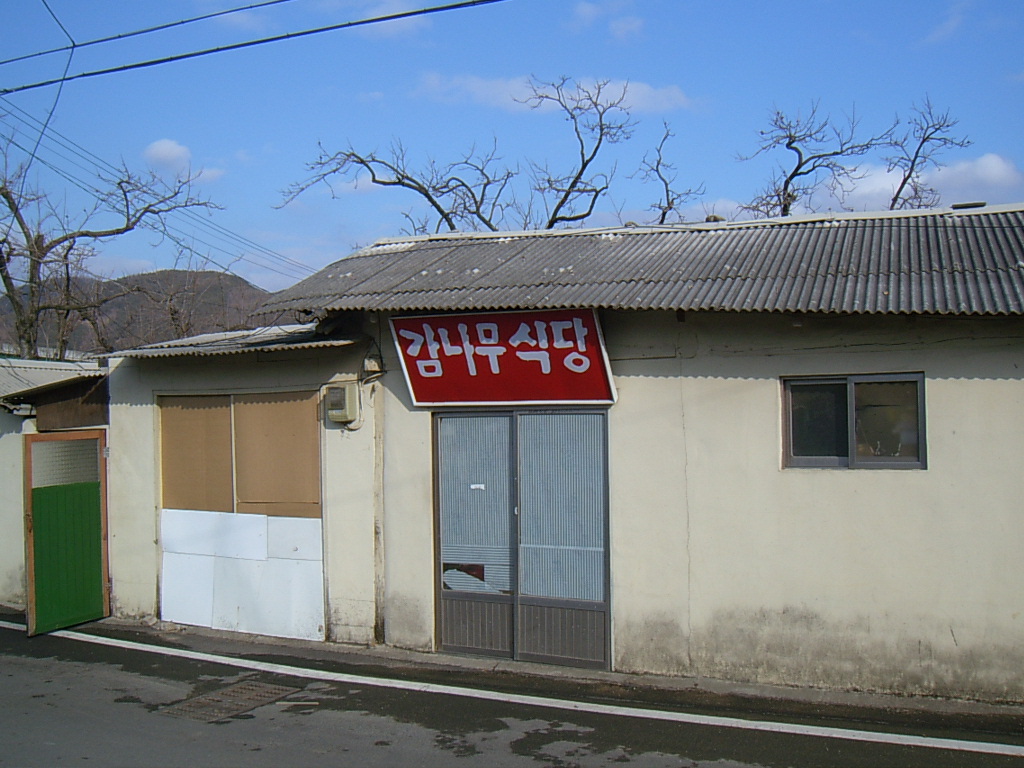
small star restaurant
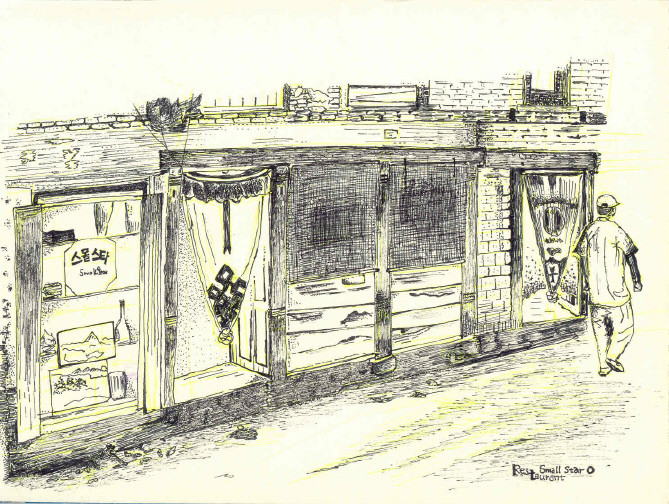
There is a famous Tibetan restaurant named Small star near Thahiti tole in Kathmandu, Nepal. Delicious, simple, cheap, friendly, warm... Who can properly describe this Tibetan restaurant? Many Koreans, Japanese, as well as some westerners, love this restaurant so much. Thunba is a traditional Tibetan hot beer. Once tasted, you will never forget !!!
You will not see the same restaurant as this picture anymore, because the Tibetan owner pulled down this old Newali building in 2003, and constructed new concrete building instead. Many foreigners remembering the romantic atmosphere feel sorry to see the new westernized building.
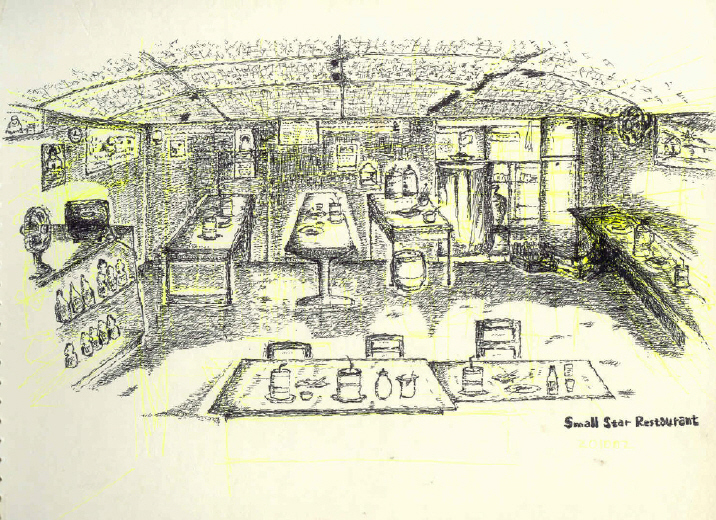
The sketch on the right depicts the interior of the restaurant. The room has simple ceiling made of bamboo and bare ground. Thunba jars are on the tables. They usually use bamboo straws to drink Thunba 3 minutes after pouring hot water into the wooden jar filled with fermented cereal from the Himalayas. Customers are advised to repeat this 3 or 4 times. I had difficulties to draw this one because of crowded customers and dimly lighted room but tried to describe the interior in detail.
Can you look for owner's license, electric rice cooker, vacuum bottles, electric fans, Dalai Lama's photo, freezer, clock, coke bottles, menu board, kitchen, towel, calendar and momo & chowmin(Tibetan food) with chopsticks?
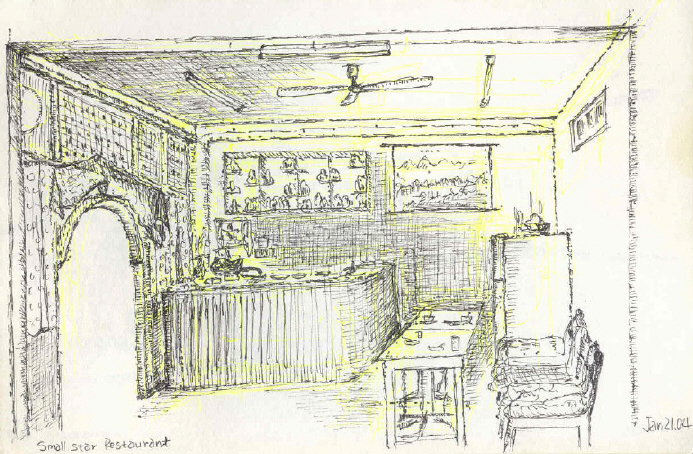
Small star restaurant was newly rebuilt at the site of the previous one in 2003. The room is very clean, light and tidy. Local people and tourists love it as it used to be. The warm-hearted owner and her family are as busy as ever. Her big and bright smile is the same as usual.
Tuesday, February 01, 2005
Kalinchowk
Kalinchowk is little known and rarely visited by tourists, compared to the other famous mountains in the Himalayas. It is located at an altitude of 3,842 m( 12,605 ft) and 18 km(11.2 miles) north of Dolakha and Charikot where my Nepali friend Udhav lives. On the top of Kalinchowk is an open-air Hindu temple dedicated to Kali, wife of God Shiva. A small pond, numerous Trishuls(tridents) and small bells are also seen around it.
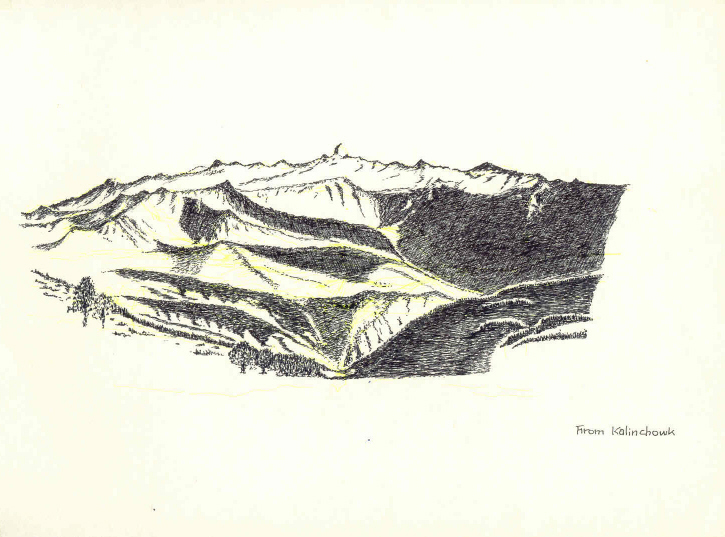
While looking from the peak, panoramic views of the Himalayan range leave one speechless. The picture above is the view from Kalinchowk. The highest peak in the middle is Choba Bamare(Udhav called it "Sumeru", a holy mountain) and Tibet is located behind it.
There are two peaks on Kalinchowk and an iron ladder connects one peak to the other one. You can see a broken house across it, which had been used for Hindu pilgrims. A small hill is behind it. Udhav and I meditated and danced there.
White clouds were approaching from the distance and passing by continuously.
Jiri is a small and remote mountain village in the middle eastern Nepal. But it is familiar to climbers and mountaineers to trek to eastern Nepal, including Mt. Everest. Jiri is one of the terminals which can be reached by bus from Kathmandu.
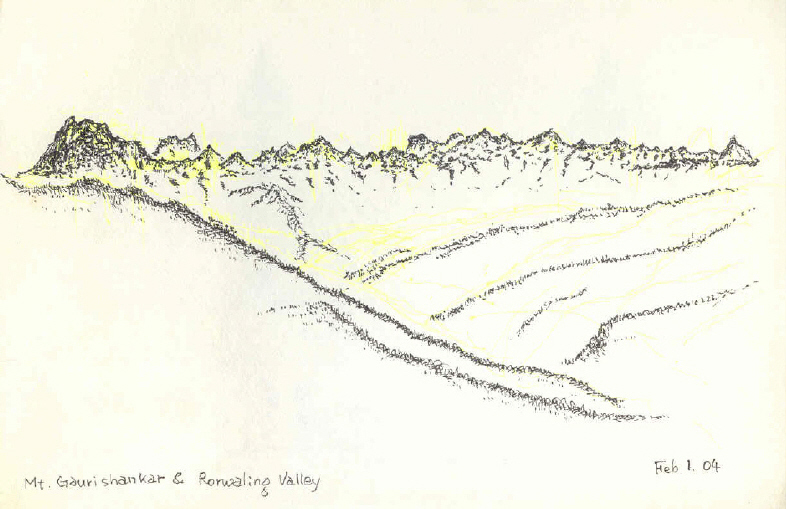
On the way to Jiri, there is so peaceful Charikot Bazar located at an altitude of 1,300 meters or so. This old village had a prosperous period in its history as a key post for trans-Himalayan trade between Nepal and Tibet. The highest one above is Mt. Gaurishankar (7,134m), and Tibet is located behind it !!!
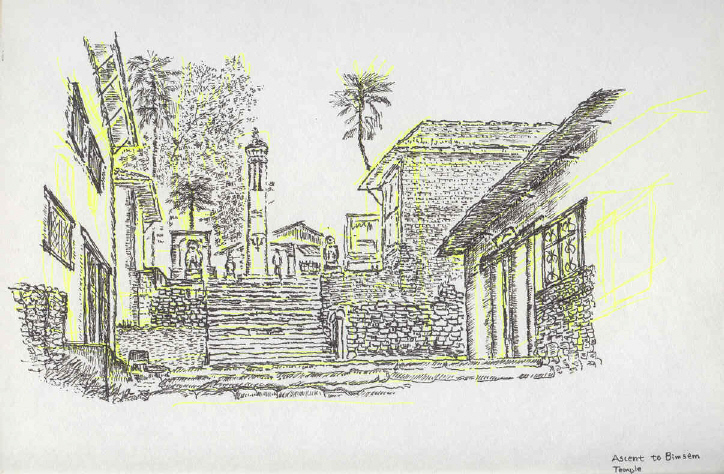
Dolakha sits nearby to the east. Bhimsem is a well known Hindu temple. There is a tall pillar made of stone in the front of the temple which was dedicated to Bhimsem, a Hindu god. People believe that the God sure helps them make more money. People praying and offering in the temple are seen from the outside. Hindus are only allowed to enter it.
I happened to meet Udhav, a Nepali teacher at a meditation center in Kathmandu in 1995. He was a simple and cheerful man who lived in Dolakha in the middle eastern Nepal. He is the first Nepali friend that I have made in Nepal. Dolakha and its neighboring village, Charikot were the ancient trading towns which had flourished trans-Himalayan trade for long.
I have been to Dolakha and Charikot several times. We used to go to a hill near the site of old Dolakha palace to relax, meditate, dance and shout, looking down the spectacular and breathless scenery of Rorwaling valley and the magnificent Mt. Gaurishankar.
The panoramic view of the Himalayas from Dolakha is beyond description and always left me speechless. Rorwaling Valley, known as one of the seven hidden valleys in the Himalayas, lies below Mt. Gaurishankar, south of Tibetan Border. They thought for a while Mt. Gaurishankar was the highest mountain in the world until they found Mt. Everest is the highest one. Gaurishankar means Lord Shiva and his wife Gauri (Parvati).
Udhav, one of the Nepali friends is a secondary school teacher in a remote mountain village named Dolakha, located somewhere in the breathtaking panoramic Himalayan range. The above drawing shows the entrance of the village, Dolakha. He loves joking, dancing, laughing and meditation so much.
Nepal is one of the materially poor countries, so rich countries have supported and assisted Nepal in many ways. Once a Japanese volunteer visited Dolakha and met some members of Red Cross. Because Udhav was also a leading member of Red Cross, the Japanese came to see him.
The Japanese asked Udhav "Is there anything that I can do to help you and your community?"
Udhav didn't answer the question for a short while and said: "Are you happy in Japan?"
That's when the Japanese got confused at the unexpected question and hesitated what to say.
Udhav said "You are not sure that you are happy in your country. If so, why do you want to help us with anything that is not happy in your country? We are happy without anything you have."
Money may buy happiness. It is not happiness but the delusion to be named as happiness though. Its name is only happiness.
... and then what is happiness?
Saturday, January 29, 2005
bridge & temples
Manyeon Gyo 만년교, a Bridge made of stone in southern Korea, which means bridge of ten thousands of years, was constructed in 1780 (Dimensions in meters: Length 13.5m, Height 5m). The bright yellow blossoms of forsythias would spread around the bridge in spring.
Yanghan 양한, a Buddhist monk, first set up this temple in 684 and Ilyeon, a famous Buddhist monk renovated it in 1263, and since then, others have ever repaired and rebuilt this old temple made of wood, stone, and soil.
They built another temple named Buk Jijang Sa 북지장사 in northern Daegu, while Nam Jijang Sa in southern. Buk means north, and Nam south. Jijang 남지장사 one of the greatest bodhisattva in Buddhism, and Sa a Buddhist temple.
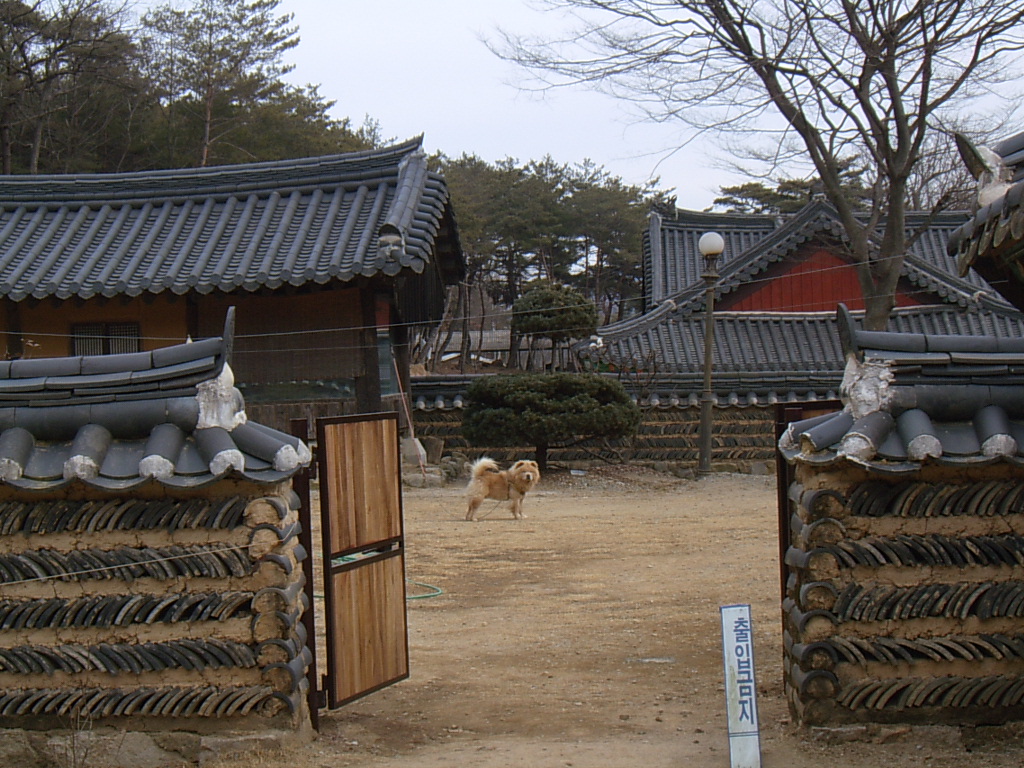
Most of the Korean Buddhist temples are located in the mountains. Buddhists think clean air, wind, and water in natural atmosphere help purify the mind. Myogak Sa 묘각사 is on the upper half of beautiful Mt. Giryong, 기룡산 too. It takes approximately 1.5 hours by car from Gyeongsan 경산. This temple was built 1,300 years ago and has been renovated several times and is a good example of the traditional architecture of the 17th century. Myogak 묘각 means mystic enlightenment.
Sunday, January 23, 2005
Monday, January 17, 2005
the road not taken
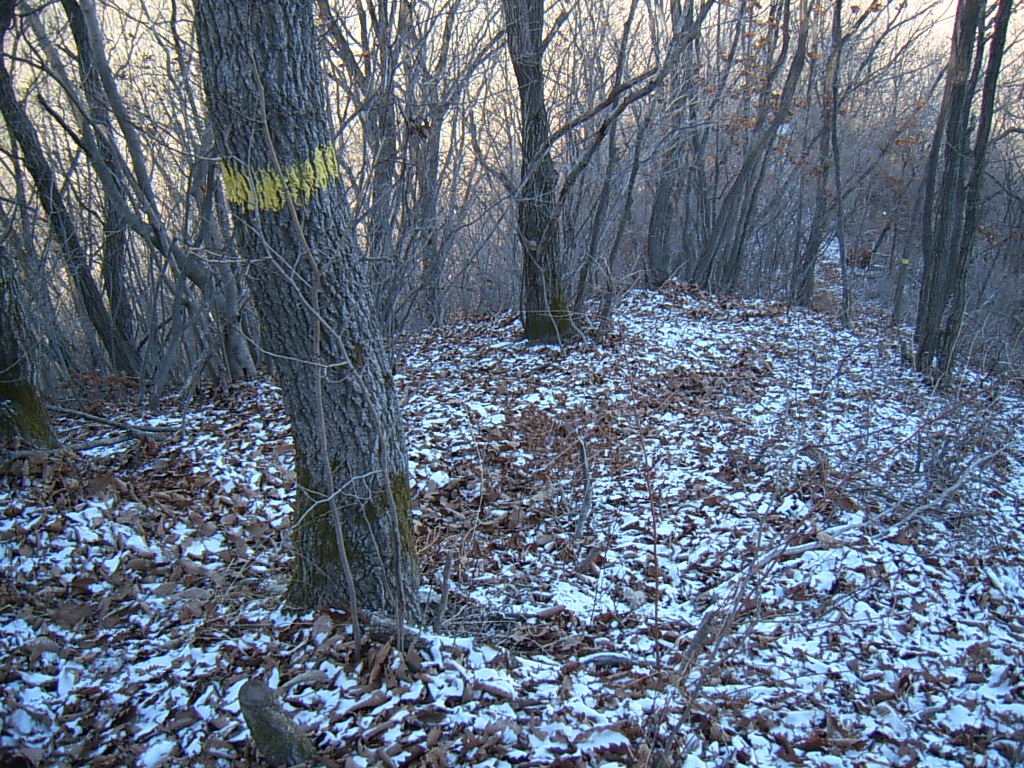
Lots of trails scatter across the mountainside. People have to select just one of them though. I sometimes remember "The road not taken" by Robert Frost while hiking. I first read the poem, translated into Korean when I was a high school student.
TWO roads diverged in a yellow wood,
And sorry I could not travel both
And be one traveler, long I stood
And looked down one as far as I could
To where it bent in the undergrowth;
Then took the other, as just as fair,
And having perhaps the better claim,
Because it was grassy and wanted wear;
Though as for that the passing there
Had worn them really about the same,
And both that morning equally lay
In leaves no step had trodden black.
Oh, I kept the first for another day!
Yet knowing how way leads on to way,
I doubted if I should ever come back.
I shall be telling this with a sigh
Somewhere ages and ages hence:
Two roads diverged in a wood, and I-
I took the one less traveled by,
And that has made all the difference.
Friday, January 14, 2005
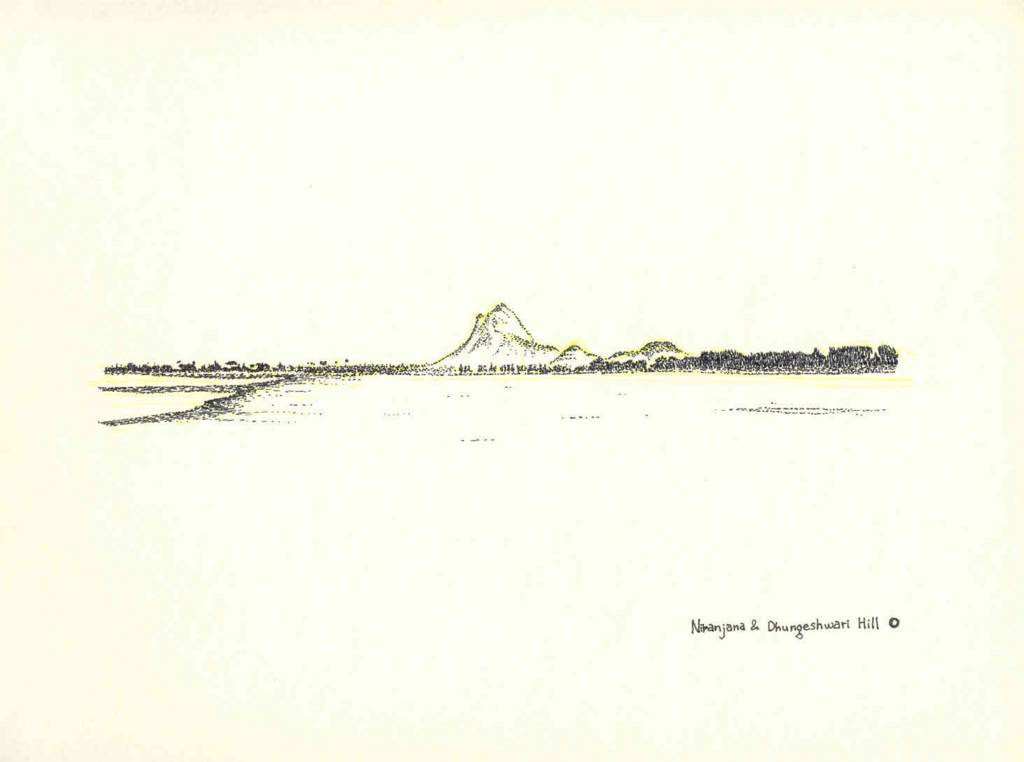
Niranjana river & Dhungeshwari
Rainy river level is very high in summer but low in the other season. I crossed the river safely in October, wearing short pants. So calm and peaceful...
Bodh Gaya is a sacred and historical place in northern India where Gautama Siddhartha was enlightened about 2,500 years ago. Before coming to Bodh Gaya and starting meditation under a Bodhi tree, he had stayed at rocky hills named Dhungeshwari near Bodh Gaya for 6 years.
Gautama had been practicing austerities for six years in this place near Niranjana river. Finally understanding that this was not able to lead to realization, he abandoned his austerities and in the nearby village, the Brahmin girl Sujata offered him milk-rice.
Saturday, January 08, 2005
Thursday, January 06, 2005
glimpse of temple
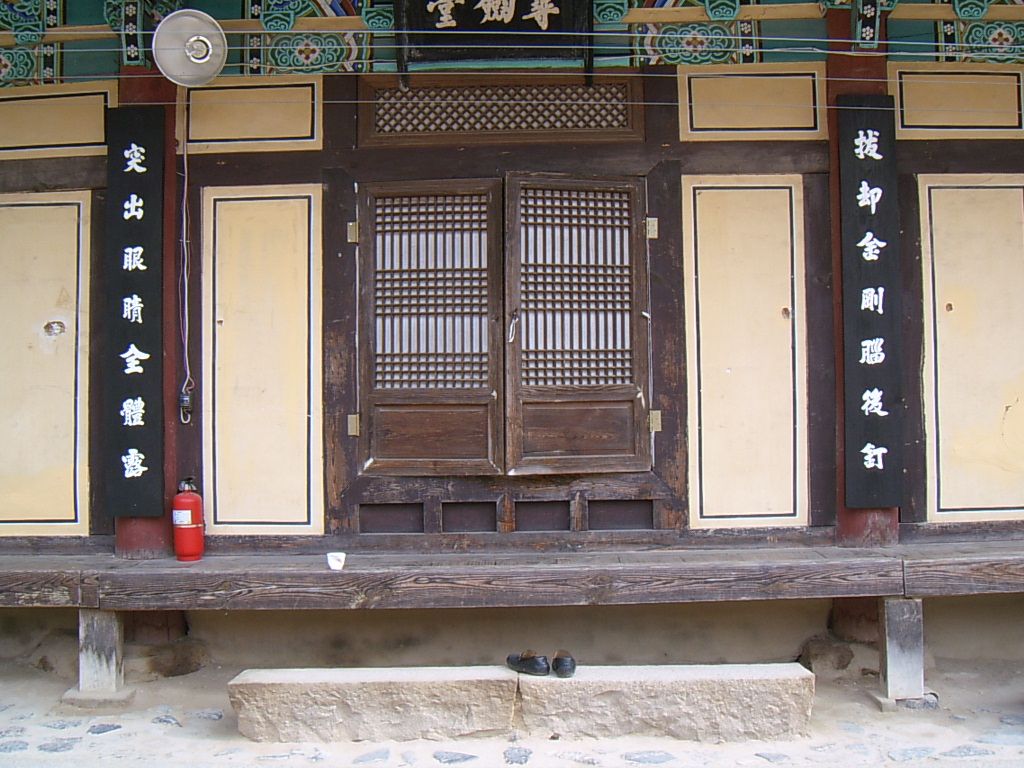
They have only lattice style doors in the front of Buddhist temples in Korea. This is one of hand carved antique wooden doors and traditional paper is pasted to the insides of the door.
A small bell named Punggyeong 풍경 hanging from the roof of a temple which is located near Gyeongsan. The other is a view from a buddhist temple's pavilion.
Tuesday, January 04, 2005
Varanasi
Varanasi, also known as Benares or Kashi, in the northern India is one of the most ancient cities of India and the oldest continually inhabited city in the world. Varanasi is regarded as India's religious and spiritual hub, which is in many senses a microcosm of India. Sometimes tourists remember that Mark Twain described it as "Older than history, older than tradition, older even than legend and looks twice as old as all of them put together." Varanasi is the city which cannot be described, only experienced.
I had stayed at Shanti guest house when I traveled in Varanasi. This budget guest house is very famous among backpackers. Shanti means peace in Sanskrit. But the building used to be a jail during the British rule in India. Indian political offenders or anti-British activists for national independence were imprisoned here. Why did British rulers set a jail in the center of Varanasi ? It seems like that they expected it to produce some psychological effects on Indians. After being liberated from British rule, the last owner of the building altered this into a guest house and built three more stories.
My room was on the highest floor and I often enjoyed the view from the rooftop. Because the area along Ghat is densely populated with residential homes that don't have enough spaces for living, the roofs are mostly used as effective living spaces and our neighborhood is overlooked by the rooftop of the guest house. I sketched the above one, facing Alamgir mosque and Malviya bridge along Ganga river.
One of the old stone-made buildings along the western bank of Ganga in Varanasi is Munshi Ghat. About 100 ghats are in Varanasi. Most ghats are used for bathing but they have also a few for cremation. Maharajas and the other princely Rulers all over the country own them as their second homes in this holy city and usually stay here during their pilgrimage to Varanasi. Munshi Ghat on the right sits along the western bank of Ganga.
One of the oldest and most sacred Ghats in Varanasi, Manikarnika is the main burning ghat. View from the eastern Ganga in Varanasi. The black one over the buildings is described as smoke from the burning dead bodies in Manikarnika Ghat, the famous crematorium in Varanasi.Dasashvamedh is the main Ghat among about 100 ones on the western bank of Ganga in Varanasi, India. This Ghat is always crowded with Indians, tourists, dogs, goats, cows, buffalos, monkeys, crows, pigeons, donkeys and so on.
You can find easily this kind of small shop in India. It seems like that this type is the original form of a convenience store. All kinds of goods such as snacks, mineral water, Cokes, cigarettes, candles, biscuits, candies, chocolates, noodles, incense sticks, lighters, chewing gums, or whatever are available here. Sometimes the owner cleans the ground around the shop because the street is always dusty and messy. A broom is seen on the ground.
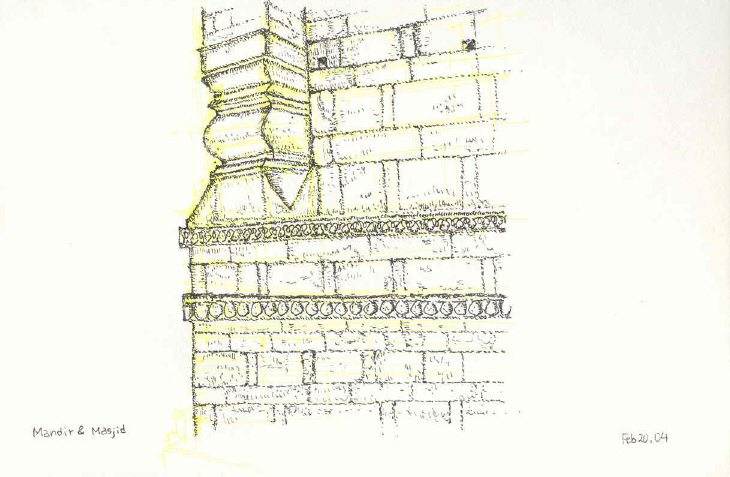
Popularly known as Alamgir Masjid(mosque) or Dharhara Masjid', it was built in the 17th century by emperor Aurangzeb(1658-1707), son of Shah Jahan (the builder of Taj Mahal), located above Panchaganga Ghat along the western bank of Ganga river in Varanasi, India. Aurangzeb destroyed most of the Mandir(Hindu temple)s during his reign. This Masjid is a blend of the Hindu and Muslim styles of the architecture.
Aurangzeb didn't tear down the previous Mandir totally, but left the base and built a mosque on it in 1669. The lower part of the decorated bricks was the base of the demolished Mandir. Many mosques were built on the sites of Mandirs during his reign, which has resulted in the fundamental tension and conflict between the two religions in India. The back of this Masjid shows a good example of ancient Hindu art.
Monday, January 03, 2005
Kathmandu, Nepal
Whenever I visited Kathmandu, Nepal, I used to stay at Yak Lodge. The residence is simple and unpretending lodge located on the upper floors of Yak restaurant in Thamel, a famous tourist area in Kathmandu. The restaurant and lodge are managed by a warm-hearted Tibetan family. Delicious western, Chinese, Indian cuisine and some local food are served at reasonable prices. It had been my second home in Nepal for ten years.
You meet easily the simple and poor villagers around Kathmandu. They look happy even if they are not rich, don't have luxury cars and houses. They like smiling and laughing so much.
Bigu means nun in Tibetan and Gompa monastery or nunnery. This Tibetan Buddhist nunnery is located in the mid-slope of Mt. Shiva Puri in northern Kathmandu, which is one of the highest mountains surrounding Kathmandu Valley.
When I went there in 2002, about 20 Tibetan nuns stayed there. They welcomed me friendly, and some Tibetan cakes and tea were served. The picture above is the main building of the nunnery, where rituals including prayer and offering are performed. Dharma Wheel flanked by two deer in the front of the roof is also seen.
In Kathmandu, Nepal, there are two viewpoints to enjoy the snow covering Himalayan range. They are Nagarkot and Kakani. Nagarkot in the east of Kathmandu and Kakani in the west are famous for its sunrise and sunset respectively. The road to Kakani and Trisuli Bazar is lined with traditional and simple houses, and numerous small villages are seen on the mountains.
The drawing on the right is described as one of the houses in those villages. Little big villages have small shops selling goods and tea. Enjoying traditional Nepali tea(Chya) or fermented milk drink(Lassi) is another pleasure of hiking here.
Godavari is a peaceful village located in the south of Kathmandu valley, Nepal. The road from Patan runs to Godavari, passing through typical Nepali villages. Royal Botanical Garden in Godavari, the only botanical garden in Nepal is worth a visit.
Godavari Kunda is very close to the botanical garden. Kunda means a holy spring in Nepali. The water is fresh, crystal clear and cold. A big mela(festival) is held every 12 years and many pilgrims come to take bath, drink, and worship. People believe that all the skin diseases can be cured after taking bath here. This Kunda is a pilgrimage place revered by both Hindus and Buddhists. The water is channeled through 5 carved stone spouts. Each spout represents Makara, a mythological water creature that looks like a crocodile.
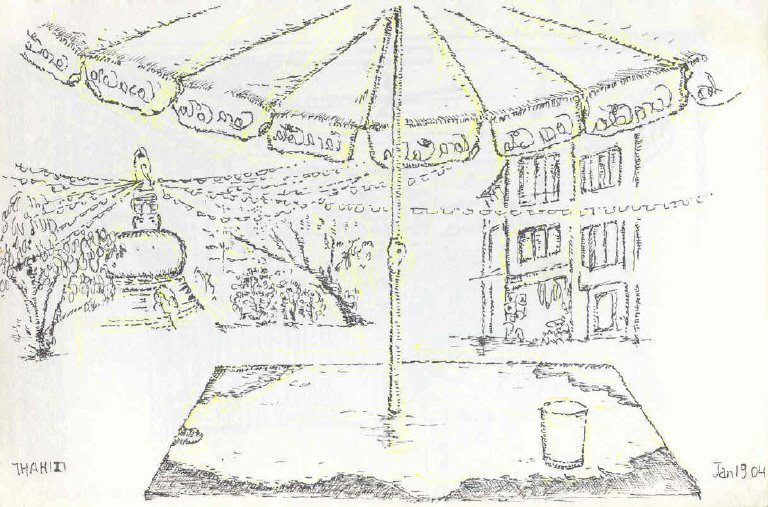
The upper ones are prayer flags, "Tarcho" in Tibetan, on which Buddhist scriptures are written.
Asan Tole, which is the heart of the market district and one of the busiest squares in Kathmandu, Nepal, has six roads radiating from it. The square is almost always crowded with shoppers.
The 6 narrow roads, that radiate from the open-air fruit and vegetable market surrounding Annapurna temple, are lined with many shops selling all kinds of household goods, dried fishes, cassette tapes, clothing, incense, footwear and spices including saffron, cardamom and many masala spice mixes that are so essential to Nepali and Indian cooking. Apart from Asan's cultural importance, it has a glorious history as a trade center. The diagonal street that passes through here was part of the legendary trade route connecting Tibet and India.
The three-roofed metal pagoda on the left is Annapurna (goddess of food grains) temple. There is only a big silver jar called kalash inside the temple for an image of Annapurna. Across the square from this temple is a two-story pagoda temple dedicated to Ganesh (the half-man, half-elephant god).
Two days before I sketched this in 2002, Maoists had called for the general strike(Bandh) across the country. Strike called by Maoist rebels in Nepal are usually strictly obeyed for fear of brutal retaliation. Businesses, markets, and schools closed in the capital. All the shops in Asan Tole were also closed and the square was so silent.
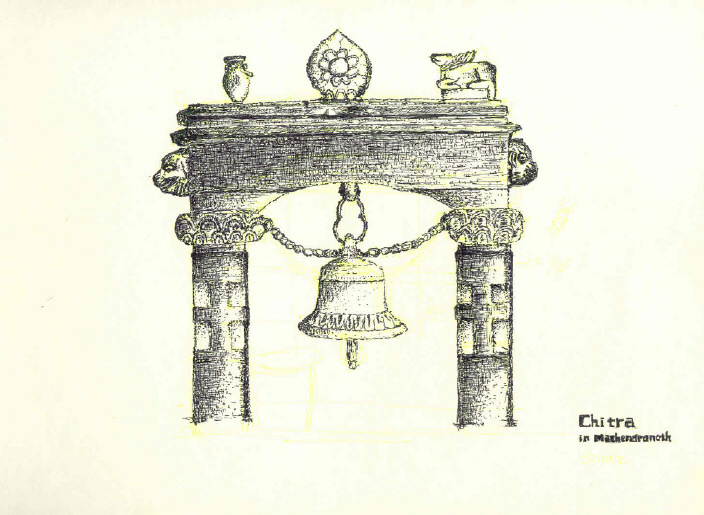
Near the old Bazar, Asan Tole, there is Machendranath Mandir dedicated to a rain god. Machendranath, who is an aspect of the Bodhisattva Chenrezig, the patron saint of Tibet is worshiped by Hindus and Buddhists alike. Hindus consider him to be an incarnation of Shiva, too.
They have several statues and bells surrounding the main temple. People ring the bells as an expression of worship. Many Hindus and Buddhists visit this temple to worship and pray in the morning and enjoy listening to Bhajan, a Hindu devotional song. A flock of pigeons also awaits the visitors.
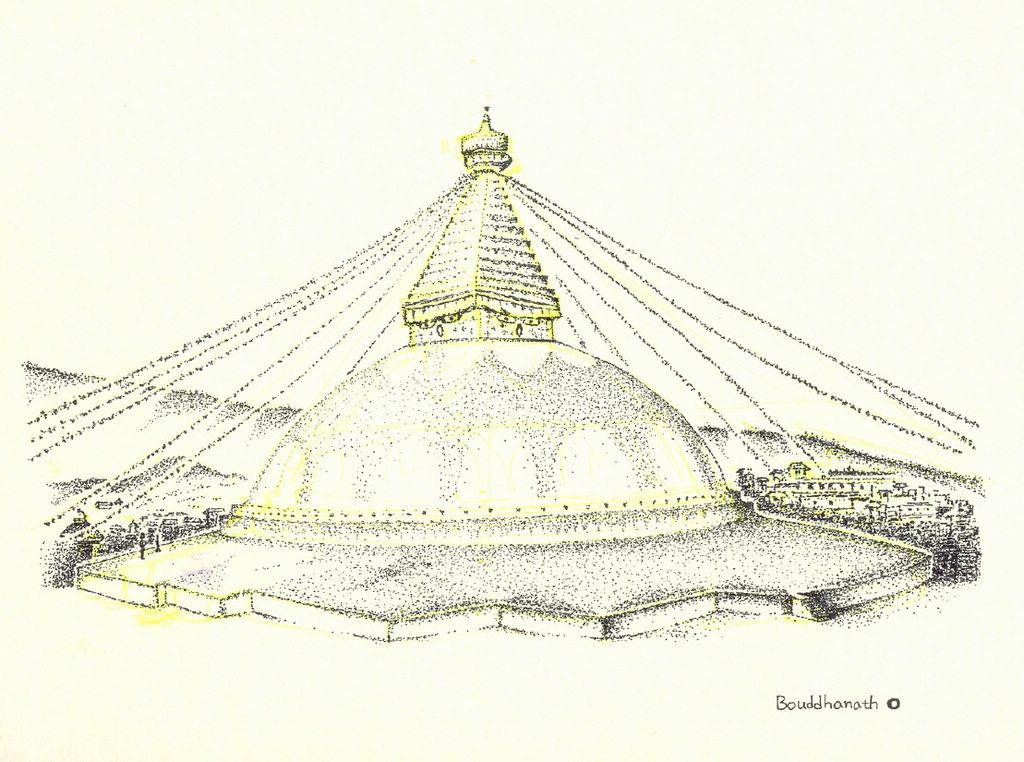
A great stupa called Boudhanath is in the northeast of Kathmandu, Nepal. As the focal point of Tibetan Buddhism in Nepal, it has been a holy and mysterious stupa among Buddhists as well as Hinduists for a long time. Many Tibetans, Tibetan restaurants, tourists, and monasteries are seen around it.
The sketch on the right side is a view from Boudhanath Stupa. This was drawn facing north, sitting on either side of the stupa.
* Stupa: Buddhist commemorative monument usually housing sacred relics associated with the Buddha or other saintly persons. The hemispherical form of the stupa appears to have derived from pre-Buddhist burial mounds in India. As most characteristically seen at Sanchi in the Great Stupa (2nd~1st century BC), the monument consists of a circular base supporting a massive solid.(Encyclopedia Britannica)
Thahiti Tole is the square near Small star restaurant and is located south of Thamel, the most popular tourist district in Kathmandu, Nepal. Thahiti is also a market square with a stupa at its center as shown in the sketch above.
Five small roads lead to Thahiti Tole which is dusty in the dry season as most parts of the city. Cars, rickshaws and motorbikes raise a lot of dust in daytime and shop-keepers sprinkle water to lay the dust at times. I had a cup of Nepali tea at a restaurant in the square and sketched the view briefly.
About 2500-year-old Buddhist temple called Swayambunath is located on a hill in the eastern Kathmandu, Nepal. This has been known to be one of the most mysterious, historical and religious places in Nepal. Various religious symbols as statues and Stupas including Hinduism ones are seen in the peaceful atmosphere. It also offers a panoramic view of Kathmandu city and the Himalayas.
This temple is also called Monkey Temple as many monkeys live on and around the hill. You can reach at the top of the hill after ascending the 365 steps and then see a huge and white hemisphere of Stupa. The pictures were sketched near the Stupa and somewhere along the steps respectively. Tibetan and Nepali vendors selling unique handmade gifts along the steps await tourists.
After Osho Rajneesh's death, one of Osho's intimate disciples set up Osho Tapoban somewhere in the dense forest of Nagarjuna near Kathmandu. Nagarjuna(circa AD 150 - 250) who was an important figure of Mahayana Buddhism was said to be enlightened in this forest. Osho Tapoban has attracted spiritual seekers around the world. In the early period of the retreat center, I also used to be one of the participants to join the meditation sessions conducted there. Osho's teaching was centered on all meditation activities.
The above drawing shows Osho Samadhi located in the lower place of the retreat center, worshiped by all Osho followers. Some of Osho's ashes are buried in the middle of round-shaped Samadhi made of marbles. Flowers are offered and incense burned.
Wherever you see a beauty: in a human face, in a child's eye, in a lotus flower, in the wings of a bird in flight, in the rainbow or in a silent rock, remember you are on the Holy ground - God is close. -OSHO-
Subscribe to:
Comments (Atom)