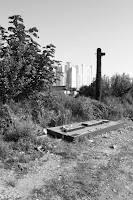
Gaya is the name of a small town in northern India, and Bodh Gaya in which Gautama Siddhartha was enlightened about 2500 years ago is nearby. Also, there used to be an ancient country whose name was the same as Gaya 가야 in southern Korea. Gaya was the confederacy of chiefdoms that existed from 1st century BC to 562 AD in the lower Nakdong river valley. Daegaya meaning Great Gaya was a chiefdom of the Confederacy, located in the present region of Goryeong 고령. Daegaya had advanced steel making craft so that it had played a major role in the Confederacy. The nearby village, Yaro, 야로, 冶爐 was the place where steel mine was found and developed in the early century. Yaro had been one of the biggest steel mines in the peninsula for a long time. Daegaya collapsed after being defeated in the battle by Shilla in 562 AD.
The ancient tombs during Daegaya Kingdom are lined along the ridge of the mountain just behind Goryeong. Historians agree that Daegaya traded with Japan 1500 years ago. Some burial accessory exported from Japan was found when one of the tombs was excavated.Sunday, April 04, 2010
Wednesday, February 17, 2010
winter view
Last Friday the snow-covered mountains around Daegu reminded us that we had a heavy snow during the night. As the sun rose, the snow on the ground started melting out because of the difference in the temperature between ground and mountains. People viewed the white mountains after a long absence and it felt more like winter.
We had much snow in those winter days. As the earth is getting warmer, the typical cold winter is the thing of the past. But compared to the previous years, this winter is colder and much snow has fallen in Daegu.
Wednesday, February 03, 2010
tomb
This hill-like tomb named Bonghwangdae 봉황대 is one of the ancient relics in Gyeongju 경주, which used to be the capital of Shilla Kingdom. The unknown ancestor buried within is silent, but only some old trees growing on it reminds passersby of the forgotten time.
The left one shows a view of Bonghwangdae in 1950's. The below one the recent view. Bonghwang means a mythical and fabulous bird, and Dae a base. It has been said that the ancient people living in Gyeongju enjoyed the panoramic view from the top of this tomb, the beautiful scenery was compared to the mythical bird and the tomb was given the name, Bonghwangdae by them.
Sunday, January 10, 2010
monk's residence
바람 없이 물결이 일지 않으면
삼라만상보다 더 많은 것이 비치네
어찌 많은 말이 필요하랴
바라보면 이미 뜻이 통하네
No wind, no swell; a world so various opens before my eyes.
No need for a lot of words; to look is to see.
(Entitled "Small Lotus Pond(작은 연못),” this is Father Kevin O'Rourke's translation of a poem by the Buddhist monk 혜심 Hyeshim (1178-1234))
Sunday, December 27, 2009
Mt. Fuji
In 1904, Japanese invaded the Korean Peninsula and some came to settle in the very small seashore village called 구룡포, 九龍浦, Guryongpo, located at the east end of the Korean peninsula. Guryongpo got its name from the legend of nine dragons that ascended into the sky over the waters off the coastal village. 구 Gu means 9, 룡 Ryong dragon and 포 Po harbor. The coastal waters off Guryongpo had a rich abundance of fishery resources. As the number of Japanese residents increased, they became richer and the village grew bigger. Lot of Japanese-style houses, a wharf facility and a park on a hill behind the village were newly built and shops including even a small department store were opened. The hill has still a wonderful view of the harbor.
As most of the Japanese buildings were made of wood, soil and cement, some houses that had been weathered the last century collapsed, and the others have been repaired and rebuilt since independence from Japan in 1945. So the original features have been changed gradually. But the Japanese traces of the colonial era could be still found in the alley. Recently an exhibition house for visitors including Japanese tourists has been opened, which used to be a typical Japanese house. The above photo shows a door with etched glass panels that is exhibited in the upstairs. The door is said to have been installed in the the other Japanese house nearby. Japanese tourists and descendants of the Japanese settlers during the colonial era are so glad to see the glass panels, the exhibition guide said. It was said that the figure etched on the upper left side depicts Mt. Fuji 富士山.
Old photos taken during the Japanese colonial period in Guryongpo are hung on the walls along the alley and old household goods are also exhibited together with the history of Japanese residents in this village.
Tuesday, December 15, 2009
Monday, December 07, 2009
winter
Banwolseong 반월성 in Gyeoungju 경주, the 1000-year old capital of Shilla Kingdom, used to be a fortress and palace whose ruins can be visited. The name, Banwol-Seong comes from its outline which was shaped like a crescent moon. Banwol means half moon and Seong fortress.
A tower of stone blocks, Cheomseongdae 첨성대, is located to the north of Banwolseong. Even if the purpose of the tower built in the 7th century still remains disputable, many historians agree with the conclusion that it was used as an observatory. Cheomseongdae was built in the reign of Queen Seonduk 선덕. A rapeseed field is located between the tower and Banwolseong.
It was very cold last Sunday. The cold wind blew across the rapeseed field. The vivid yellow of the rapeseed flowers couldn't be seen. The dried lush green leaves remind frequent visitors of the rapeseed flowers in full bloom last spring instead.
Thursday, October 15, 2009
river
The two rivers, 낙동강 Nakdong-gang and 금호강 Gumho-gang meet near Hwawon resort. The smaller river, Gumho enters Nakdong, the longest river in the southern peninsula. From the pavilion on the top of the resort, people enjoy the surrounding landscape, including the mouth of Gumho river. The right side river from the pavilion is Gumho. 신천 Shinchun, the urban stream in Daegu is a branch stream of Gumho River.
Tuesday, September 22, 2009
autumn
노곡리 Nogok-ri is an obscure village to the west of Dasan, which is located across Nakdong river from Hwawon resort, western Daegu. Nogok got its name from the place with plenty of fertile rice field. Before the bridge linking Hwawon resort and Dasan about 20 years ago was built, the villagers, mostly farmers, used to cross the river by ferry for a long time. The new bridge has changed the villagers' lifestyle a lot in the past years. New residents from the city came to live in this village surrounded by the fresh air and natural environment. About 150 households lived in the village in the past. Now about 120 households remain. Most young people have left the village to study or get jobs in the big cities, as in the other Korean rural villages. So old men remain in the village and cultivate the soil.
A big zelkova tree over 460 years old stands alone on the top of the front hill of the village and a small chapel is nearby. There are some benches around the tree. Behind the hill, Nogok-ri village is crammed into the narrow space between two hills. The top of the hill offers a quiet and peaceful landscape of the rice field. There was a primary school at the foot of the hill, but the number of pupils had been continuously decreased, so the primary school was finally closed last spring.
Autumn is the best season in Korea. The rice fields turn yellow. It is getting close to harvest in Nogok-ri.
Sunday, August 02, 2009
Friday, July 17, 2009
pavilion & forest
Jain 자인 is a small and peaceful village to the east of Gyeongsan. It has a well-preserved natural forest called Gyejeong 계정. During Joseon 조선 dynasty, local residents used to lay memorial stones for the former governor after he finished his term and left his post. The memorial stones for the former governors in Jain 자인 are lined up at the entrance of Gyejung. The stones usually say that local residents expressed their gratitude for the former governors' commitment to fairness and justice during their term. The sub-county office pavilion built during Joseon dynasty is also located on the hill of the forest. It was moved from the place where it was first built in Jain area. This photo shows the view from behind the pavilion.
Gyejeong is also the place where Jain Dano 단오 General Han 한장군 Cultural Festival 놀이 is celebrated annually on May 5th of the lunar calendar. It is unique that the historical story of General Han, who defeated Japanese pirates molesting villagers in this region about one thousand years ago, was made into the event, which was mixed with the traditional 단오제 Danoje, Dano festival. Dano traditionally marks the beginning of summer, when rites of wishing for an abundant harvest for the year following planting in the spring were held. After General Han drove them away, he became a patron of Jain, villagers built a shrine in memory of him, and traditional ceremonies have been held in every Dano festival. His grave is in the middle of the forest.
Wednesday, June 03, 2009
rural side
This photo shows that a cattle pen is located on either side of the house in a country village near 탑리 Tap-ri. The rural view like this in South Korea is not common in countrysides anymore. 한우, Hanwoo, Korean native cattle are the traditional native breed which was in the past usually bred to plow fields, make manure and pull carts. It has a coat color ranging from yellowish brown to dark brown.
Most farmers used to raise a very small numbers of the cattle. For some children living in country villages, grazing cattle on grass used to be their daily round after school.
Wednesday, May 27, 2009
sesame oil shop
탑리, Tap-ri is a small farming village located somewhere in the eastern inland of the peninsula. 탑 Tap means stupa or pagoda in Buddhism. In the center of the village, 5 story pagoda which is over 1000 years old stands on a small hill, looking down on the village.
An edible oil shop can be found in the nearby traditional market. Something is written on the windows of the front door as follows: 참기름 Sesame, 뜰기름 perilla, 식용유 edible vegetable oil and 간장 soy sauce. Many shops around it were renovated and rebuilt, but it seems like that this oil shop has not been changed since being opened first. The signboard says Tap-ri sesame oil shop. Two machines in front of the shop are expeller on the left and roaster. Two wooden chairs on the left look like the same ones that have been used by primary school students about 30 years before.
Monday, May 25, 2009
evergreen tea shop
A rustic coffee shop named 상록수 Sangroksoo meaning evergreen is on the roadside in 청하 Cheongha area near 보경사 Bogyung Buddhist temple. The notice on the door says that it is open for business and the room is air-conditioned. Some plants and flowers can be seen in the little garden in front of the shop. 다방 Dabang in Korean means a room for tea or coffee.
The room on the left side of the building was used as a pub named 상록수 Sangroksoo, now closed, and is available for rent.
Sunday, May 03, 2009
two aromatic trees
Dalsung 달성 in Daegu valley had been a mud and stone-reinforced fortress since Silla 신라 dynasty(BC 57 ∼ AD 935). It had been a strategic hub in the valley. But its strategic importance had been diminished since Daegu fortress was built on the plain nearby, which was aimed to defend the valley people from Japanese invasion. In 1970, Dalsung was renovated to become a park and zoo.
In the late 19th and early 20th century, Japan had a deliberate intention to colonize Joseon 조선 and proceeded to occupy her. On Jan 12, 1909, Sunjong 순종, the last King of the Joseon Dynasty and Ito Hirobumi 伊藤博文, the resident-General of Joseon together visited Dalsung in Daegu. They planted two aromatic trees in memory that were brought from Japan. When they planted the trees, the ages of the trees were 33 and 66 years old respectively, which were the same as those of King Sunjong and Ito Hirobumi. The trees have grown bigger over 100 years and still stand side by side in the middle of the park, without any signs that indicate the event 100 years ago. A Chinese proverb says "Same bed, different dreams." Looks like their wishes regarding the future of the country were totally different. The tree planted by the King is on the right in the view from the park gate of Dalsung.
About 9 months later after their visit to Daegu, Ito Hirobumi was assassinated in north China by a Korean independence activist. King Sunjong's reign also ended when Japan annexed Joseon as a colony in 1910.
Sunday, April 12, 2009
On the Way Home
A group of marathoners taking part in 2009 Daegu International Marathon race is running on the street of downtown Daegu. You can see a strangely dressed runner among them. The marathoner is a Korean Buddhist monk. He puts on the monk robe instead of a marathon wear, unlike the other marathoners, even when running.
Online news reports said that he resolved to start out in the marathon to spread Buddhism and has participated in marathon races including ultramarathon several times. He is now an abbot monk of a Buddhist temple somewhere in the southern region.
Tuesday, April 07, 2009
Something Forgotten
Japanese colonialists completed a single track railway in 1905, connecting 한양 Hanyang, the capital of 조선 Joseon dynasty and 부산 Busan, the largest port city on the peninsula. Hanyang is the previous name of 서울 Seoul. The railway had many curved sections so steam locomotives couldn't run fast and it took about 30 hours from Seoul to Busan. Five months later, steam express locomotives were introduced to shorten the running time, which was cut down to 11 hours.
Japanese imperialists opened a war against China in 1937, needed a railway to transport war materials faster so that they completed the double track railway later, completely separated from the first one. The second railway was a modernized one whose track was more straight.
The old first railway had been abandoned since the new one was opened to traffic. Since then, many sections of the railroad have disappeared due to urban and rural development, or new roads were built on the site of the old railway. Some tunnel on the railway is used for persimmon wine cellar whose name is wine tunnel 와인 터널, located near the pass between 청도 Cheongdo and 경산 Gyeongsan. Some section of the railroad with two tunnels, located near 밀양 Miryang, was paved and used as a car road. The single track railway is not wide enough for two cars to pass, so one of two cars heading in the other direction should wait at the tunnel entrance while the other one passes through it.
Sunday, March 22, 2009
Raw Fish Slices
The restaurants specialized in sliced raw fish can be seen along the busy streets in harbors on the coasts of the Korean peninlsula. Sliced raw fish, 회, Hoe, is one of Korean favorite dishes, which is the same as Sashimi in Japan. The above photo shows a saltwater fish aquarium equipped in the front of raw fish restaurant located in some harbor, on the eastern coast. Aquarium is applied as a temporary storage to keep the live fish fresh until ready to serve. A landing net is used to catch the fish out of the aquarium, which is thinly sliced into bite-size pieces.
Sliced raw fish are served with red pepper sauce flavored with vinegar, Gochunaengi 고추냉이(Green horseradish), soy sauce mixed with vinegar and pine-nut meal, white cabbage, garlic, green chilli, sesame leaves. The aquarium fish of the restaurants along the coast are mostly wild caught. But to meet the needs, it has been known that some fish are transported from the hatcheries located along the western and southern coasts. Most inland raw-fish restaurants use fish raised in farms. The most popular main ingredients for sliced raw fish are flatfish, southern conger eel, armorclad rockfish, oyster, spiny turban shell, cuttlefish, octopus, abalone, yellowtail, snapper, mullet, halibut, gizzard shad and tuna.
Monday, February 16, 2009
Judgement
Once upon a time, there lived an old man who owned a wonderful horse on the frontier of China. One day, the horse jumped a fence and ran away. His neighbors came to comfort him. But he looked so peaceful and serene. He said, "Don't judge, who can say this may be good or bad?"
A few months later, the horse returned home and came back along with a group of horses. His neighbors came around again. The old man was congratulated by them, but he said: "Don't judge, who can say this may be good or bad?"
A few days later, his son went out riding on the horse, fell down from the new horse and had his leg broken. Everyone in the village came to comfort him again. However, the old man said, "Don't judge, who can say this may be good or bad?"
Some days later, the country where the old man lived got engaged in the war against its neighborhood, so all the young men in the village were drafted to fight in the war. Most draftees were killed in the battle. However, his son was not conscripted to fight in the war because he was a cripple. Everyone in the village said to the old man, "Your son is so lucky." However, the old man said, "Don't judge, who can say this may be good or bad?"
Tuesday, January 06, 2009
Winter Delicacy
Pacific herrings are dried on the seashore located in Yeongdeok region, a county along the eastern coast. Fish internal organs are removed and put on the bank of the sea. Seagulls gather to eat them.
For the regional people along the eastern coast during the winter season, enjoying little dried Pacific herrings together with dried laver, red pepper sauce flavored with vinegar, brown seaweed, white cabbage, garlic, green chili and onion used to be a local delicacy. Little dried pacific herrings are garnished with dried laver, green onion, and brown seaweed to get rid of the fishy smell. The fishes are usually eaten, wrapped in the dried laver or white cabbage, together with others prepared. Their skins are so tough that they should be peeled off first and the flesh cut into bite-size pieces.
Little dried Pacific herrings have recently gained considerable popularity across the country. But these days Pacific sauries are currently used instead of Pacific herrings which are not caught enough to meet the needs.
Friday, December 19, 2008
bridge & river
왜관, Waegwan, the name of the administrative district to the north of Daegu, is located next to the Nakdong River, connected by three bridges. Two bridges among them were completed by Japanese colonialists for military purposes, the older one was built in 1905. Waegwan means literally the official residence for the Japanese during Joseon dynasty. There used to be a Japanese settlement in Waegwan.
During the Korean War in the summer of 1950, the area around Waegwan was one of the most intense battlefields as Communist North Korean forces attempted to cross the river and push south through Waegwan toward Daegu. ROK and US forces formed a defensive line along the banks of the Nakdong River in order to deter the enemy's advance. Two spans of the bridges were then destroyed by an explosion ordered by a commander of the US army to prevent the suspicious refugees, believed to be North Korean soldiers disguised in civilian clothes, from crossing the river.
In 1953, the Korean war, the first major armed clash between the free world and communist forces ended with a truce, claiming millions of lives and causing incalculable economic and social damage. The photo shows the bridge built in 1905, which was repaired temporally and opened for public traffic after the war. It was reinforced again and reopened only for pedestrians in 1993.
Wednesday, December 10, 2008
Christianity in Daegu
After the Roman Catholic Church was first introduced to the peninsula in 1784, Catholics were brutally persecuted on charges of accepting the religion of so-called Western barbarians for about 100 years. In 1880th, Christians were finally legalized to share and expand their faith.
In 1903, Gyesan Cathedral 계산성당 was built as a parish church of the Daegu Archdiocese 대구 교구 and the first Gothic-style church in this region, as the Catholic church began to exert its influence on Daegu and Gyeongbuk 경북 district.
A missionary named William M. Baird was dispatched to Joseon 조선 by the Northern Presbyterian Church in America in summer of 1890. He left San Francisco for Joseon with his wife, and 70 days later arrived at Busan port in late January 1891 by way of Hawaii and Japan. He stayed at Busan area for about two years and preached the gospel. But he wished to spread the Good News of Jesus Christ to Gentiles in Daegu and the Gyeongbuk area to the north of Busan, and decided to go on a missionary trip to the region.
He began a journey on foot from Busan, went along the local roads, crossed streams and rivers sometimes, and got to Cheongdo 청도 on the afternoon of April 21, 1893, and finally arrived at the southern gate of Daegu fortress one day later, which means that for the first time a Protestant missionary arrived in the area. Since then, the other Protestant missionaries had arrived, and western civilization and culture, as well as the gospel, were introduced into local people. And they opened schools and hospitals as they did in other areas.
Apple trees were also brought into Daegu from America and flourished quite well in the soil of the Daegu region. Later, Daegu got the reputation as a city of apples. The offspring of the first apple trees planted by the American missionaries are still alive on the hill behind Dongsan Medical Center, founded by them. Their old-fashioned and American-style residences are also close to it and well-preserved.
The above two photos represent some views of the high school established by an American missionary in 1906. Visitors can see some letters on the right side of the main entrance to the main building. The letters "헨더슨 紀念館" inscribed into granite stone indicate Henderson Memorial. Henderson was the 4th principal of the school.
Red bricks and stones were used to build the walls of a building in the school. After the Daegu fortress was broken and dismantled, a few discarded stones were recycled here.
Sunday, November 30, 2008
late autumn
The photo at the top was taken at Gyeongsang Gamyeong Park 경상감영공원 sited in downtown Daegu. The others show Shilla tombs, Gyeongju.
Saturday, November 01, 2008
Gampo harbor
감포 Gampo is one of the administrative areas on the eastern coast of the peninsula, located to the east of Gyeongju city. It takes about 40 minutes by bus from Gyeongju Bus Terminal to Gampo Harbor. Fishing was great all along the sea around Gampo, so during the colonial age, the Japanese developed it as a major fishing base. Gampo is still one of the major fishing harbors along the eastern coastline. Pacific saury, anchovy, ray, sea mustard, and abalone are caught in and around the shore.
Restaurants specialized in Korean-style seafood stand close together along the nearby street right next to the sea in the port, and local shops and street vendors selling dried fish and seaweed are lined up along the market street. Compared to the tourist area, old Gampo, to the north of the market area, offers a peaceful atmosphere. Visitors feel like some Japanese style houses on the slope talk silently to the strangers about their forgotten past.
About 4 years ago, Gampo used to be packed with tourists on weekends who wished to taste various seafood like slices of raw fish, broth, and stew, and buy seafood. But since the construction of the expressway linking Daegu and Pohang was completed in 2004, the number of visitors has considerably decreased. Since then, many tourists have crowded to the nearby big harbor, Pohang, because they can shorten and save the driving time to get to the eastern coast and taste the fresh seafood.
Sunday, October 05, 2008
autumn views
A Korean proverb says that during autumn the sky is high and the horses get fat. Autumn has come to the field, too. The above photo indicates the paddy field near 영해면 Yoeonghae-myeon county subdivision of 영덕군 Yeongdeok-gun County, the eastern coastal area. Yeonghae offers a panoramic view of the plain along the coast. Since the ancient times, this small town has been inhabited and regarded as a central place in remote mountain, coastal and field villages around it. So, many historical sites are scattered across this area.
Lotus leaves and sky reflected in a pond.
Monday, September 15, 2008
story of Du Sachung
Toyotomi Hideyoshi 豊臣秀吉, who had unified Japan in 1590, was never satisfied with the island country and decided to begin the invasion of the continent to stabilize the internal political situation after unification. Hideyoshi intended to conquer Myeong China, 명 (明, Ming in Chinese accent), and thought that Joseon was not a foe worthy of his steel and requested it to allow undisturbed passage into China. Joseon was the name of Korea during the period of Joseon dynasty(AD 1392 to 1910). Joseon refused the demand totally, and Hideyoshi finally ordered to launch the invasion of Joseon. Japanese forces invaded Joseon in 1592 and battles had continued on the peninsula till 1598. Myeong Dynasty also dispatched an army and navy, a total strength of about 100,000 to assist Joseon while Japan invaded Joseon.
Most Koreans don't know what or who Du Sachung is, even most citizens of Daegu don't know either. But history should not be ignored or forgotten. This is the story of a foreigner who lived in Daegu in 16't century. His life was closely related to the war that Hideyoshi started on the peninsular in 16th century.
두사충, 杜思忠, Du Sachung was the name of a General from Myeong, served as a staff officer under the direction of an Admiral, and offered counsel on battle position and encampment. Actually, he was well acquainted with 풍수, Pung su (風水, Feng shui in Chinese accent), the theory of divination based on topography. 풍 Pung literally means the wind and 수 Su water. During his stay in Joseon, he distinguished himself in battles against Japanese forces and held a favorable image of Joseon called "Eastern Nation of Decorum."
When Hideyoshi died in 1598, the seven-year war also ended, resulting in numerous losses of human life and irrevocable damage to historical and cultural legacies. Troops from Japan and Myeong also returned home. But Du Sachung and his two sons didn't and decided to stay in Joseon instead. Later they became naturalized in Joseon and settled in Daegu. For his distinguished services to Joseon, Joseon government donated them the land which is presently the area of Gyeongsang gamyeon 경상감영 慶尙監營.
He had also ordinary emotions and feelings like others. He longed for his country and family in Myeong when he got older. So, he made a move to the place at the foot of the southern mountain of the valley, which is presently the area of 대명동 大明洞 Daemyeong Dong in Namgu district. He then named the area Daemyeong Dong, meaning Great Myeong. He built an altar for worship, and on the first day of lunar month, he wore an official robe and saluted in the direction of the emperor of Myeong so far away.
After death, he was buried at the foot of a mountain which is presently near Nambu(Southern) bus terminal or Manchon subway station. When he was alive, he had already located the site where he was buried. Momyeong Jae 모명재 慕明齋, a traditional Korean pavilion for performing sacrificial rites for Du Sachung and his descendants, can be seen on the way to his grave. Momyeong is his pen name and means longing for Myeong. His and his descendants' tombs are scattered around the nearby hill. Two stone statues of scholars, generals, and animals lined up in rows facing each other in front of two tombs symbolize that they protect the departed, which is derived from the Confucian tradition.
The photo depicts one of two stone statues of the scholar in Momyeong Jae, which was previously located in front of one of the tombs.
Wednesday, September 03, 2008
Upo
우포 Upo which is west of Changyeong county is known for swamp(wetland), which is one of Nature's treasures in Korea. The swamp would be easily accessible from all directions and the main gate is about 15 minutes drive from Changyeong Interchange. The below one shows a nearby farm road leading to the swamp.
Saturday, August 16, 2008
across the water
반야용선도, 般若龍船圖, Banya-yong-sun-do means a painting of dragon vessel of wisdom. Prajna in sanskrit or Banya means wisdom of enlightenment, yong dragon, sun vessel and do painting. So, this painting depicts the scene that a group of enlightened people sail across the suffering world toward the paradise by vessel of wisdom. Dragon-shaped vessel means wisdom to free from suffering. Two people on the prow and stern of the vessel symbolizes Bodhisattvas steering it and guiding the passengers that imply enlightened ones.
Sometimes Buddhist temples in Korea or their main halls symbolize Banyayongsun itself. When visitors look around the main gates of Buddhist temples or stylobate of the main halls, dragon, turtle or crab-shaped carving in wood and stone can be seen. The above one shows the Tongdosa version of Banyayongsundo, which was painted in 1896 on the backside of a building in Tondosa. The below one is a stone bridge near one of the main gates of the monastery.
Sunday, August 10, 2008
temple & village
This marker is designed for the visitors to the main hall of a traditional Buddhist temple established in 824 during Shilla Kingdom, 석남사 Seoknamsa well known for a monastery for Bikkhuni in sanskrit, Buddhist nuns.
Seoknamsa is one of the branch temples of Tongdosa. The mountain range with Mt. Gaji in the background contains a connected series of mountain peaks including Mt. Unmun on which Unmunsa, a major historical Buddhist monastery for Bikkhuni is located somewhere.
Summer views of traditional village near Hwawon in the eastern Daegu.
Thursday, July 31, 2008
modern history of Daegu
Daegu fortress which was constructed in 1736 and demolished in 1907, used to be in the middle of Daegu valley. At first, it was built of soil in 1590 and destroyed by Japanese invaders two years later. Historically, it was aimed to protect local people from Japanese invaders. But it was ironically destroyed by pro-Japanese district governor named 박중양, Pak Joong Yang who spoke Japanese very well. Before Japan captured Joseon in 1910, many Japanese immigrated to Daegu to make money. But they were not able to have any land and wanted to own land for business and living. Pak decided privately to dismantle the fortress to secure land for Japanese without any permission from the government. Pak was later branded as a national traitor and punished after liberation from Japan.
The fortress had the shape of a quadrangle and four big gates. A French traveler who had visited Beijing in China wrote his impression of Daegu fortress "as a miniature of the castle in Beijing, “ describing the panoramic view of picture perfect field of autumn and the nearby river from the fortress. Today the scale of the fortress can be traced through four roads that lied on the same place of the fortress after the destruction, which were named after their position as follows: Dong-sung-ro, Seosungro, Namsungro, and Buksungro. Dong, Seo, Nam, and Buk mean east, west, south, and north respectively. Sung means fortress and Ro road. The roads are together connected, forming a quadrangle with angles. The circuit of the fortress walls was about 2.65km(1.65mile) and the height 5.6m(18.35ft).
With the fortress demolished, the Japanese were permitted to start building shops and residences along both sides of the site of the former fortress. It is still easy to find many Japanese style buildings along Buksungro. Huge amounts of stone from the fortress demolished were recycled in many ways and some are still found in the forms of cornerstones of a nearby church, residences of American missionaries, and gardens. At the sites of four gates in four directions lie small stone markers.
The governor in charge of Gyeongsang district, the southeastern region of the peninsula, during Joseon dynasty resided in the Daegu fortress. 경상감영, Gyeongsang gamyeong, district governor's office and residence (color photos), was located away from the site of western gate named Dalseomun (the above photo) of the fortress. This area later became a park with the same name, well known among the locals.
A stone marker which some Chinese character is carved stands at the exit of the park. The usual transportation used by the upper class during Joseon Dynasty was the horse but some areas were allowed to ride horses only for special personnel. During the time, this park area belonged to the district governor, so the stone marker indicates that anyone below the rank of district governors must dismount from the horse before entering this area.
Subscribe to:
Comments (Atom)