Sunday, July 17, 2005
Saturday, June 25, 2005
The Korean War(June 25, 1950~ July 27,1953)
The Korean War broke out on June 25, 1950, when North Korean troops crossed the 38th parallel, the dividing line between the two Koreas, invading the South. The United Nations forces from 16 countries, including the United States, Britain, Turkey, and Australia, supported the South against the communist North backed by China.
The photos show refugees moving to the south in the east of South Korea(July 28, 1950) and a war orphan crying on the street(Aug. 8, 1950).(Image files from National Archives and Records Administration, US)
Thursday, June 23, 2005
Wednesday, June 08, 2005
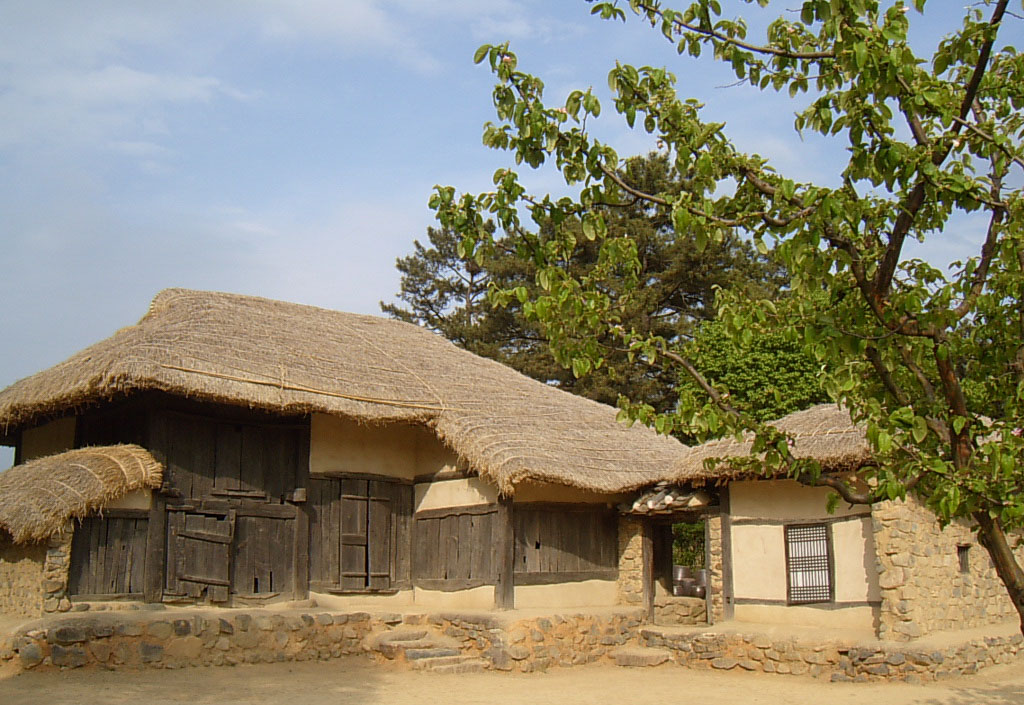
magpie house
This old and characteristic house had been built and used by Koreans living in the cold areas. The roof is made of rice straws, and rooms for people and cowhouse are together inside the walls. The owner wanted to protect his family and livestock from the sharp coldness of winter. A big door to cowhouse is seen on the left.
There are two holes in the middle of the roof, which were designed for good ventilation. People call this magpie house because the holes just look like magpie's nests.
Saturday, May 28, 2005
small sketches
Various living things are found in nature. It seems like that they have their own language and world. Sometimes some of them look as busy as human beings. It is surprised to see them work very hard without any stress and rest.
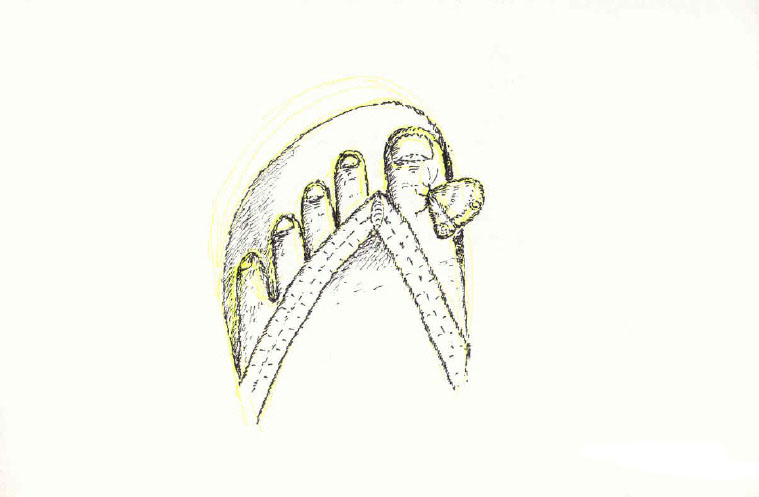
This sandal made in Thailand is very light, comfortable and cheap. I often take a walk wearing this one. One sunny day, a butterfly sat on my big toe while I was sitting in the woods, and it was sketched briefly.
Road, stream and cherry trees are sketched, and stepping stones across the stream are also seen.
Birds & Ladybug-beetle
Chao Phraya River in Bangkok
Stuff on the desk
Monday, May 23, 2005
Saturday, May 21, 2005
old building in Tansen bazar
Tansen is one of the most impressive towns of Nepal, which, still untouched by many tourists, is located on a large plateau at an elevation of 1,350m (4,430 ft). This bazar in the middle of town was set up by Newari merchants from the Kathmandu to take advantage of the trade route between India and Tibet.
Narrow stone-paved streets are lined with old brick buildings and filled with simple village life. Tansen is a great place for walking, too. Maps and a brochure guide for walking tours of the town are available at the tourism office.
The picture above is one of old brick buildings along the bazar streets. A Nepali restaurant was across from it and I sketched this from there. From the very left, shoe shop(closed), grocery store, stationery store, and electric appliance shop.
Regular buses leave for Tansen from Kathmandu (8-10 hours). Tansen lies 40 km north of Butwal. Lumbini, the sacred birthplace of Buddha, lies 40 km southwest of Butwal. Belahiya( referred to as Sonauli in India side), the most popular border village crossing between Nepal and India is very close to Lumbini.
Wednesday, May 18, 2005
mountain road & railway station
There were lots of unpaved roads in the past. But it is getting difficult to find them. The picture above shows a forest road near Gyeongsan. Only a very few people are usually seen on it. I just sometimes meet a group of mountain bikers while walking along this road. This dusty unpaved one always reminds me of the past time that will never return. Such is life?
It has been raining in front of Daegu railway station. People wait for buses at the bus stop in the early evening.
Friday, May 06, 2005
spring in Gyeongju
Gyeongju 경주 lies about 70 km east of Gyeongsan. It was the capital of the Silla Kingdom for 992 years(B.C 57 - A.D 935). Gyeongju Historic Areas contain a variety of outstanding examples of Korean Buddhist art, in the form of sculptures, reliefs, pagodas, and the remains of temples and palaces, so it is often called an open-air museum.
In the middle of Gyeongju, just outside the downtown area, is Banwolseong(반월성, half moon palace) site, upon a crescent shaped hill; it is one of Silla's palace ruins. To the south Namcheon(남천, the south stream) forms a natural defense.
The tombs near the center of Gyeongju, about 70 km east of Gyeongsan were constructed during the early stages of Silla dynasty and have yielded many treasures, including a gold crown.
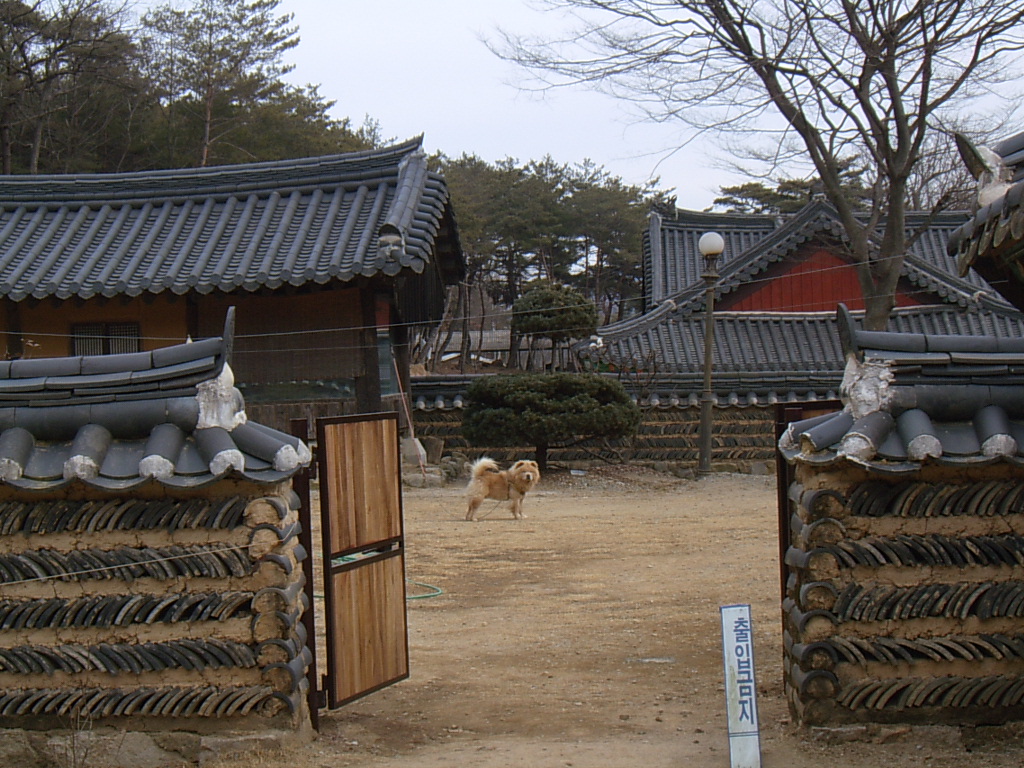
Gate of traditional Korean house. People walk along the same path.
Down from Banwolseong in Gyeongju, Cheomseongdae Observatory built in the middle of the 7th century is located. The observatory consists of 362 granite stones. A rapeseed field between Banwolseong and Cheomseongdae.
Wednesday, March 30, 2005
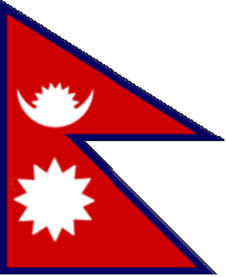
Origin of the flag of Nepal
When I stayed in Nepal, I had been to many Hindu temples and found pennant-looking decorations made from copper at the gates of the temples. The moon on the left represents the royal house. The sun on the right symbolizes a branch of the Rana family. The below one is the holy jar called Parna Kalash. The flag of Nepal (Nepal Ko Janda) is the only non-rectangular national flag, based upon the two separate pennants. The flag of Nepal is on the right.
Sunday, March 27, 2005
slogans
Let's study hard! (On the left side)
Success in life depends on how you spend three years in high school!Slogans were written on the wall outside a high school in Gyeongsan. During the military dictatorship, numerous slogans were easily visible on the streets in Korea. Time has passed, though. Some Koreans still love slogans as well.
Wednesday, March 16, 2005
Sunday, February 27, 2005
Tuesday, February 22, 2005
Monday, February 14, 2005
Tuesday, February 08, 2005
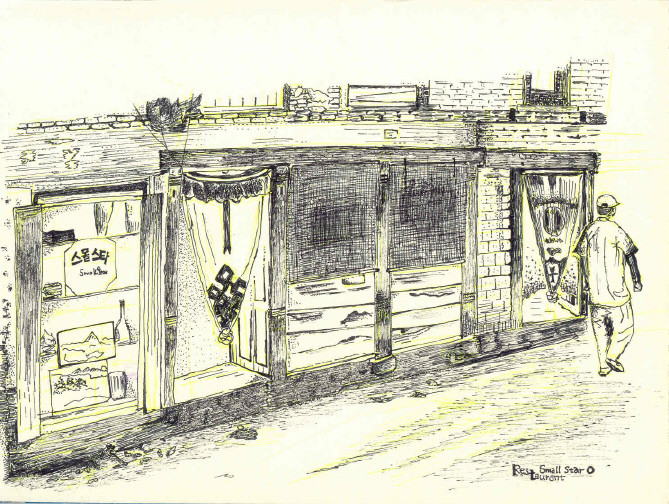
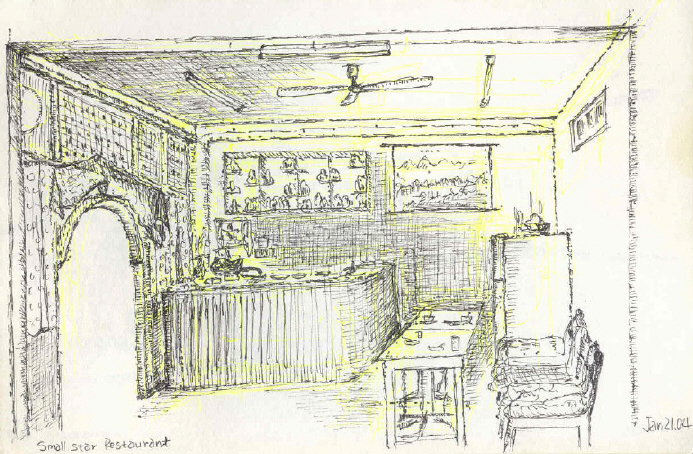
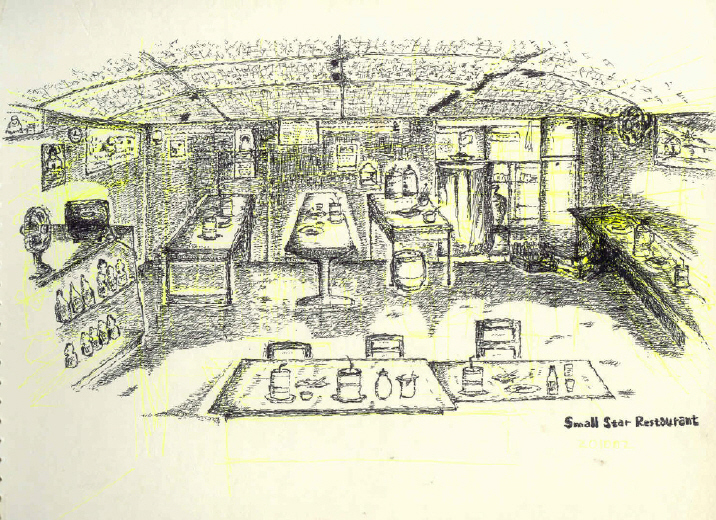
small star restaurant
There is a famous Tibetan restaurant named Small star near Thahiti tole in Kathmandu, Nepal. Delicious, simple, cheap, friendly, warm... Who can properly describe this Tibetan restaurant? Many Koreans, Japanese, as well as some westerners, love this restaurant so much. Thunba is a traditional Tibetan hot beer. Once tasted, you will never forget !!!
You will not see the same restaurant as this picture anymore, because the Tibetan owner pulled down this old Newali building in 2003, and constructed new concrete building instead. Many foreigners remembering the romantic atmosphere feel sorry to see the new westernized building.
The sketch on the right depicts the interior of the restaurant. The room has simple ceiling made of bamboo and bare ground. Thunba jars are on the tables. They usually use bamboo straws to drink Thunba 3 minutes after pouring hot water into the wooden jar filled with fermented cereal from the Himalayas. Customers are advised to repeat this 3 or 4 times. I had difficulties to draw this one because of crowded customers and dimly lighted room but tried to describe the interior in detail.
Can you look for owner's license, electric rice cooker, vacuum bottles, electric fans, Dalai Lama's photo, freezer, clock, coke bottles, menu board, kitchen, towel, calendar and momo & chowmin(Tibetan food) with chopsticks?
Small star restaurant was newly rebuilt at the site of the previous one in 2003. The room is very clean, light and tidy. Local people and tourists love it as it used to be. The warm-hearted owner and her family are as busy as ever. Her big and bright smile is the same as usual.
Tuesday, February 01, 2005
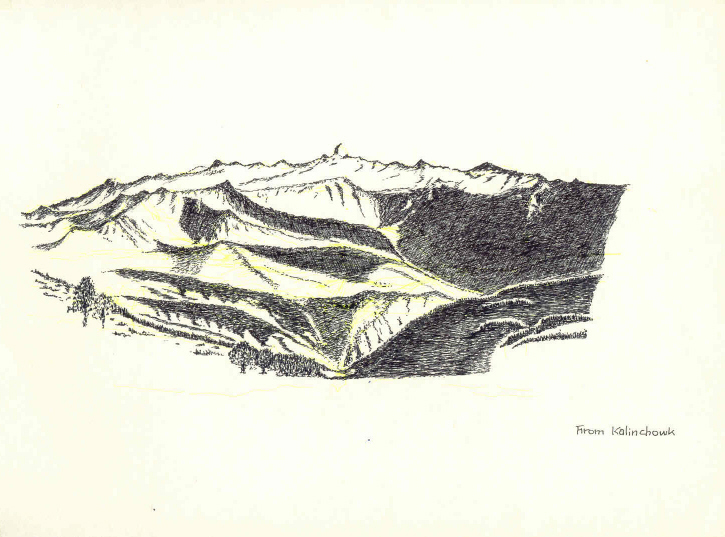
Kalinchowk
Kalinchowk is little known and rarely visited by tourists, compared to the other famous mountains in the Himalayas. It is located at an altitude of 3,842 m( 12,605 ft) and 18 km(11.2 miles) north of Dolakha and Charikot where my Nepali friend Udhav lives. On the top of Kalinchowk is an open-air Hindu temple dedicated to Kali, wife of God Shiva. A small pond, numerous Trishuls(tridents) and small bells are also seen around it.
While looking from the peak, panoramic views of the Himalayan range leave one speechless. The picture above is the view from Kalinchowk. The highest peak in the middle is Choba Bamare(Udhav called it "Sumeru", a holy mountain) and Tibet is located behind it.
There are two peaks on Kalinchowk and an iron ladder connects one peak to the other one. You can see a broken house across it, which had been used for Hindu pilgrims. A small hill is behind it. Udhav and I meditated and danced there.
White clouds were approaching from the distance and passing by continuously.
Jiri is a small and remote mountain village in the middle eastern Nepal. But it is familiar to climbers and mountaineers to trek to eastern Nepal, including Mt. Everest. Jiri is one of the terminals which can be reached by bus from Kathmandu.
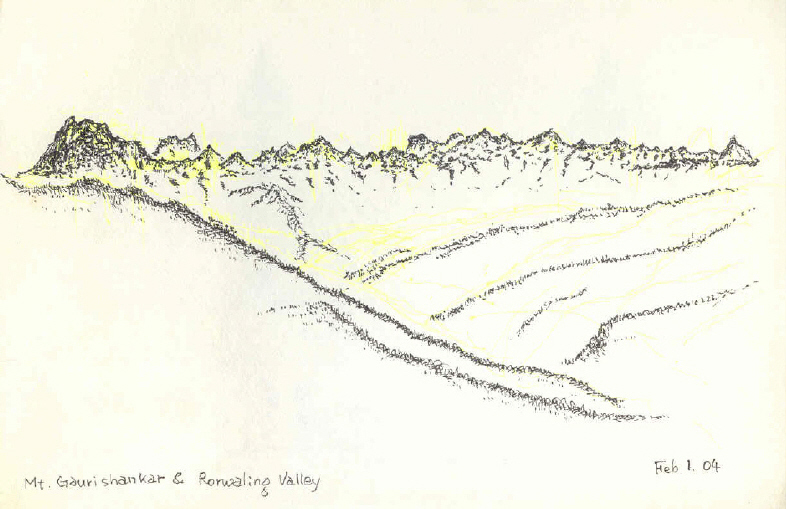
On the way to Jiri, there is so peaceful Charikot Bazar located at an altitude of 1,300 meters or so. This old village had a prosperous period in its history as a key post for trans-Himalayan trade between Nepal and Tibet. The highest one above is Mt. Gaurishankar (7,134m), and Tibet is located behind it !!!
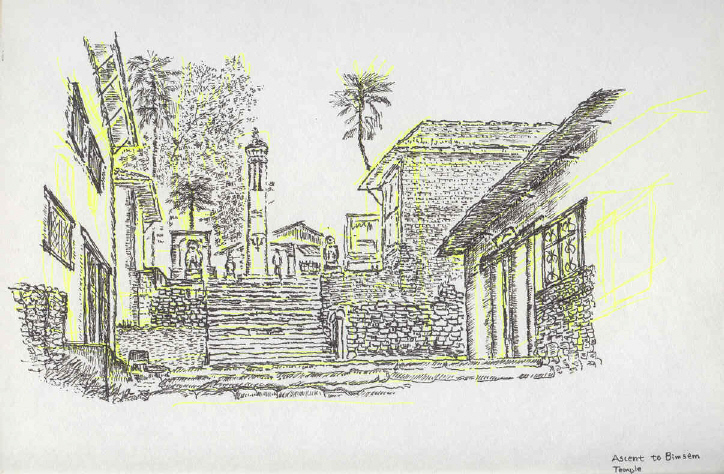
Dolakha sits nearby to the east. Bhimsem is a well known Hindu temple. There is a tall pillar made of stone in the front of the temple which was dedicated to Bhimsem, a Hindu god. People believe that the God sure helps them make more money. People praying and offering in the temple are seen from the outside. Hindus are only allowed to enter it.
I happened to meet Udhav, a Nepali teacher at a meditation center in Kathmandu in 1995. He was a simple and cheerful man who lived in Dolakha in the middle eastern Nepal. He is the first Nepali friend that I have made in Nepal. Dolakha and its neighboring village, Charikot were the ancient trading towns which had flourished trans-Himalayan trade for long.
I have been to Dolakha and Charikot several times. We used to go to a hill near the site of old Dolakha palace to relax, meditate, dance and shout, looking down the spectacular and breathless scenery of Rorwaling valley and the magnificent Mt. Gaurishankar.
The panoramic view of the Himalayas from Dolakha is beyond description and always left me speechless. Rorwaling Valley, known as one of the seven hidden valleys in the Himalayas, lies below Mt. Gaurishankar, south of Tibetan Border. They thought for a while Mt. Gaurishankar was the highest mountain in the world until they found Mt. Everest is the highest one. Gaurishankar means Lord Shiva and his wife Gauri (Parvati).
Udhav, one of the Nepali friends is a secondary school teacher in a remote mountain village named Dolakha, located somewhere in the breathtaking panoramic Himalayan range. The above drawing shows the entrance of the village, Dolakha. He loves joking, dancing, laughing and meditation so much.
Nepal is one of the materially poor countries, so rich countries have supported and assisted Nepal in many ways. Once a Japanese volunteer visited Dolakha and met some members of Red Cross. Because Udhav was also a leading member of Red Cross, the Japanese came to see him.
The Japanese asked Udhav "Is there anything that I can do to help you and your community?"
Udhav didn't answer the question for a short while and said: "Are you happy in Japan?"
That's when the Japanese got confused at the unexpected question and hesitated what to say.
Udhav said "You are not sure that you are happy in your country. If so, why do you want to help us with anything that is not happy in your country? We are happy without anything you have."
Money may buy happiness. It is not happiness but the delusion to be named as happiness though. Its name is only happiness.
... and then what is happiness?
Subscribe to:
Comments (Atom)